Breaking Toxic Cycles in Immigrant Families
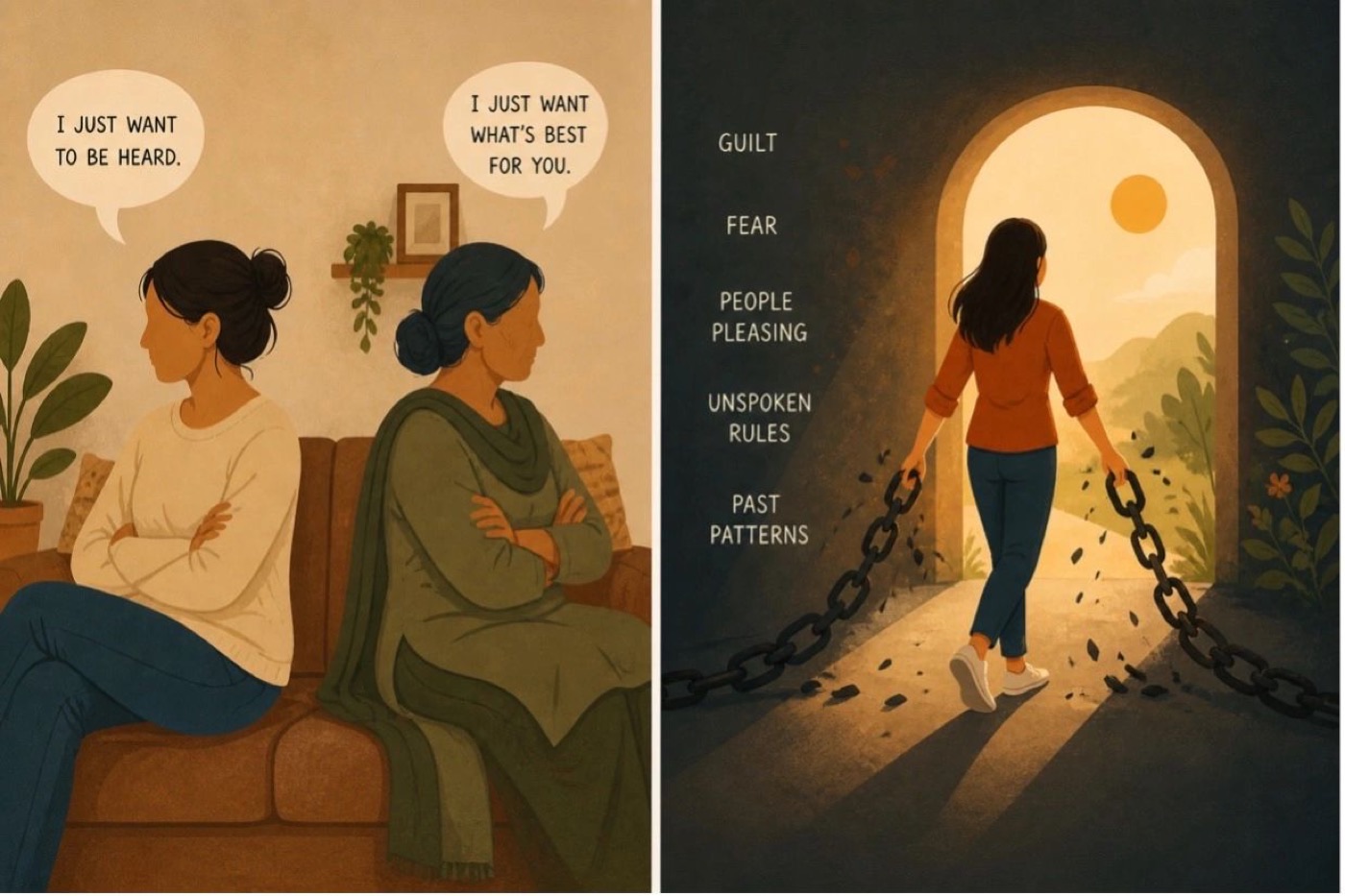
There’s a quiet pattern many people in immigrant families recognize—but don’t always have the language to describe.
It often sounds like:
- “Don’t talk back.”
- “We sacrificed everything for you.”
- “What will people say?”
- “Family comes first.”
- “You should be grateful.”
- “Other kids don’t behave like this.”
These phrases are often framed as respect, discipline, love, or cultural values. And sometimes, they genuinely are rooted in care and protection. But for many people, underneath these messages exists something heavier: emotional pressure, guilt, fear, silence, and expectations that leave little room for individuality, emotional safety, or self-expression.
What makes this dynamic so difficult is that it’s rarely talked about openly. Many individuals grow up believing their distress is simply part of being a “good child,” a “good daughter,” or a “good son.” They may feel conflicted for even questioning these patterns because love and pain are often deeply intertwined within immigrant family systems. From a clinical perspective, many of these dynamics can be understood through the lens of intergenerational trauma.
What Is Intergenerational Trauma?
Intergenerational trauma refers to emotional wounds, survival patterns, coping mechanisms, and relational behaviors that are unconsciously passed down from one generation to the next. Immigrant parents and grandparents often carry experiences that were never fully processed:
- Poverty or financial instability
- War or political unrest
- Displacement and migration
- Racism and discrimination
- Loss of identity, language, community, or social status
- Emotional neglect within their own upbringing
- Pressure to survive rather than emotionally connect
In survival environments, emotional expression is often viewed as weakness. Vulnerability may not have felt safe. Individuality may have been discouraged because obedience and sacrifice were necessary for survival. As a result, many parents unintentionally parent from fear rather than emotional security. Not because they do not love their children—but because survival shaped the way they learned to give love.
How Trauma Quietly Gets Passed Down
Trauma is not always passed down through abuse or overt harm. Sometimes it is transmitted through expectations, emotional responses, silence, or relational patterns.
It can show up as:
1. High Expectations Tied to Worth
Achievement becomes linked to love, acceptance, or family pride. Children may grow up feeling:
- “I am only valuable when I succeed.”
- “If I disappoint my family, I am failing them.”
- “Rest is laziness.”
- “My emotions matter less than my responsibilities.”
This can create chronic anxiety, perfectionism, overachievement, and burnout later in life.
2. Emotional Invalidation
Many individuals from immigrant households hear messages such as:
- “You’re too sensitive.”
- “Stop crying.”
- “Other people have it worse.”
- “Why are you depressed? You have everything.”
These responses are often attempts to toughen children for a difficult world. But emotionally, they teach people to disconnect from their feelings rather than understand them. Over time, many adults struggle to identify emotions, ask for support, or feel deserving of care.
3. Guilt as a Form of Control
In many immigrant families, guilt becomes normalized. Parents may unintentionally use sacrifice as leverage:
- “After everything we’ve done for you…”
- “We gave up our whole lives for this family.”
- “You owe us.”
This creates an emotional conflict where children feel responsible not only for their own lives, but also for their parents’ happiness, stability, and sacrifices.
As adults, many people then experience:
- Intense guilt for setting boundaries
- Fear of disappointing others
- Difficulty saying no
- Chronic people-pleasing
- Anxiety around independence
The “In-Between” Experience
Many children of immigrant families grow up feeling emotionally split between two worlds.
On one side there’s independence, emotional openness, boundaries, self-expression and personal freedom.
On the other, there’s loyalty, obligation, cultural expectations, family reputation and fear of hurting loved ones.
This internal push-and-pull often creates emotional exhaustion. Many individuals carry these struggles quietly for years because culturally, there is often little room to discuss emotional pain openly.
The Emotional Cost of Survival-Based Family Systems
When emotional needs are consistently minimized, many individuals develop coping patterns that help them function—but slowly disconnect them from themselves.
These patterns may include people-pleasing, emotional suppression, hyper-independence, anxiety, perfectionism, fear of conflict, difficulty trusting others, chronic guilt, burnout and emotional numbness.
Some individuals become highly successful externally while internally feeling emotionally exhausted, unseen, or disconnected. The nervous system remains stuck in survival mode long after the original survival threat is gone.
Breaking the Cycle Is Not Betrayal
One of the biggest misconceptions about healing intergenerational trauma is the belief that setting boundaries means rejecting your culture or abandoning your family. It doesn’t. Breaking the cycle is not about blaming parents or dismissing their sacrifices. It’s about recognizing that pain can be passed down unintentionally—and deciding that it stops with you. You can honour your culture while also protecting your mental health. You can love your family while also acknowledging harmful patterns. You can appreciate sacrifice without sacrificing yourself.
Two Ways to Begin Breaking the Cycle
1. Name the Pattern Without Shaming Yourself
Awareness is one of the most powerful starting points in healing.
Begin noticing:
- Do you feel guilty for setting boundaries?
- Do you apologize excessively?
- Do you equate love with obedience?
- Do you fear disappointing others more than abandoning yourself?
- Are your emotions often minimized or dismissed?
- Do you struggle to identify what you actually want?
When you label these experiences as learned relational patterns rather than personal flaws, shame begins to loosen.
The narrative shifts from:
- “Something is wrong with me”
To:
- “This is something I learned in order to survive and stay connected.”
That shift matters deeply.
2. Practice Compassionate Boundaries
Boundaries do not have to be cold, aggressive, or disrespectful. In many cultures, direct confrontation feels unsafe or emotionally overwhelming. That’s why compassionate boundaries can be especially important.
Instead of: “You never listen to me.”
Try: “I want to have a better relationship with you, and for that, I need space to express myself without feeling dismissed.”
Instead of: “Stop controlling my life.”
Try: “I understand you worry about me, but I also need room to make decisions for myself.”
Boundaries rooted in clarity and care are still boundaries. And yes—they will feel uncomfortable at first.
Not because you are doing something wrong, but because you are doing something unfamiliar. Your nervous system may interpret boundary-setting as danger because historically, conflict may have threatened connection, approval, or emotional safety. That discomfort is part of unlearning survival patterns.
Intergenerational trauma is complex because it often exists alongside love, sacrifice, resilience, and cultural pride. Many immigrant parents did the best they could with the emotional tools they had. But survival is not the same as emotional wellness. And what protected one generation may quietly wound the next if left unexamined.
Healing begins when we create space for both compassion and accountability:
- Compassion for where these patterns came from
- Accountability for how they continue
The goal is not perfection. The goal is awareness, healthier relationships, emotional safety, and the freedom to exist as a full human being—not just a role, responsibility, or expectation.
References
Artiga, S., & Ubri, P. (2017). Living in an immigrant family in America: How fear and toxic stress are affecting daily life, well-being, & health. Menlo Park, CA: Kaiser Family Foundation.
Sethi, S., & Sethi, S. (2026, March 21). How the Trauma of Immigration Can Harm the Developing Brain: An Interview with Harvard’s Martin Teicher. MindSite News. https://mindsitenews.org/2026/01/08/how-the-trauma-of-immigration-can-harm-the-developing-brain-an-interview-with-harvards-martin-teicher/
Cauley, K. C. (2024). IT DIDN'T START WITH YOU: HOW INHERITED FAMILY TRAUMA SHAPES WHO WE ARE AND HOW TO END THE CYCLE. Family Systems: A Journal of Natural Systems Thinking in Psychiatry & the Sciences, 18(2)
- Family Therapy
- Immigrant Families
- Toxic Cycles