Stress in Your 20s: Why It Hits So Hard (and What Actually Helps)
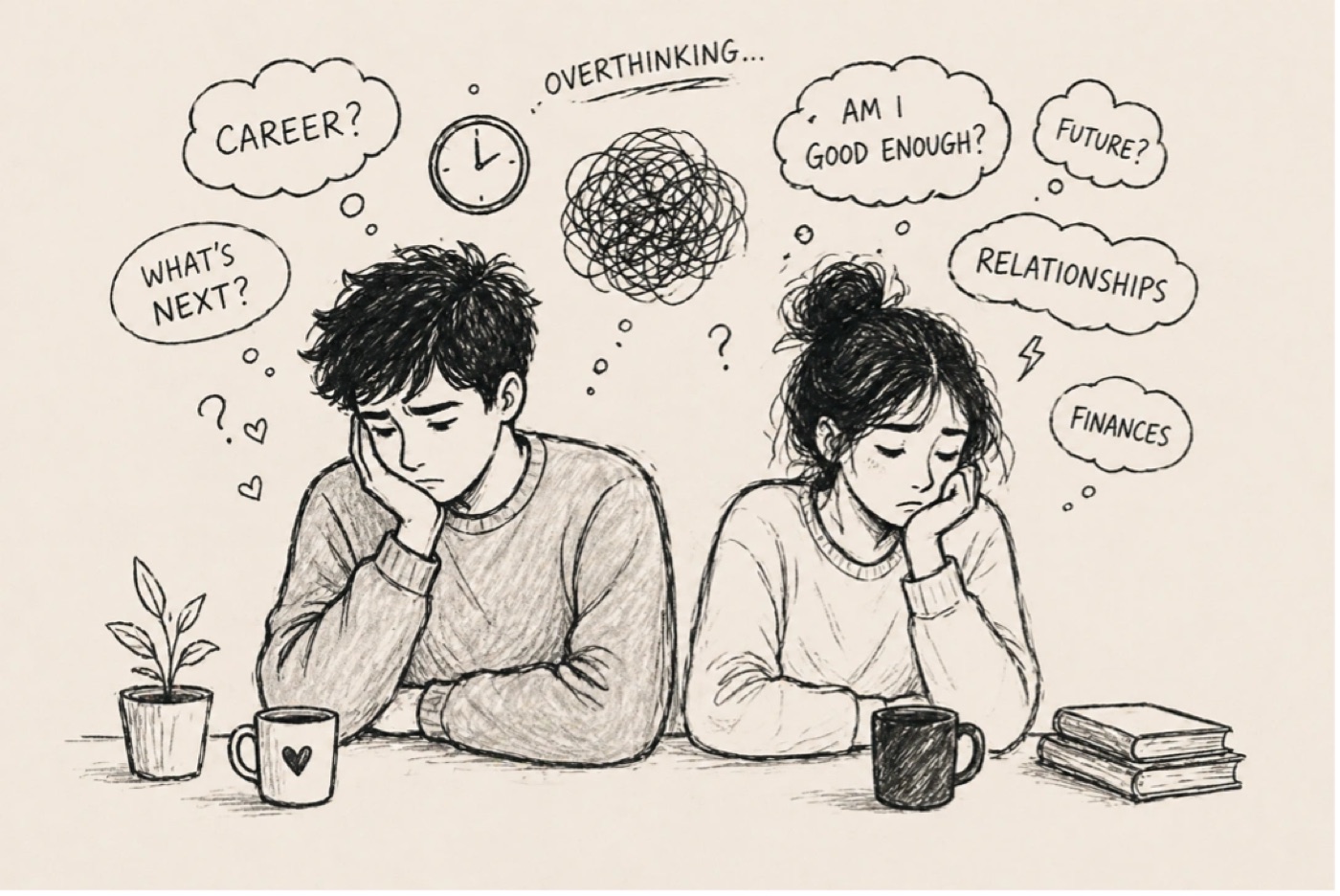
Your 20s can feel like a constant tension between
“I should have it together by now” and
“I have no idea what I’m doing.”
One moment you’re motivated. The next, you’re overwhelmed—questioning your career, your relationships, your direction, your purpose. This isn’t random. And it’s not just “stress.” There are real psychological processes underneath this experience.
What Makes Your 20s So Psychologically Intense
1. You’re in a Peak Phase of Identity Formation
From a developmental perspective, your 20s are not meant to feel stable.
This stage is often associated with identity exploration—figuring out your values, beliefs, roles, and direction. Unlike earlier stages where structure is externally provided (school, family expectations), this phase requires self-authorship.
That shift—from being guided to guiding yourself—creates internal pressure.
You’re no longer asking:
“What am I supposed to do?”
You’re asking:
“What do I want—and how do I know if it’s the right choice?”
That question doesn’t have immediate answers. And sitting in that uncertainty can feel deeply unsettling.
2. Decision-Making Carries a False Sense of Permanence
Many people in their 20s experience decision paralysis, not because they’re incapable—but because decisions feel irreversible.
Thought patterns often sound like:
- “What if I choose wrong?”
- “What if this sets me back years?”
- “What if everyone else moves ahead while I’m stuck?”
This reflects a cognitive distortion known as catastrophic forecasting—overestimating the long-term impact of a single decision. In reality, most life paths in your 20s are far more flexible than they feel. But your brain is wired to seek certainty, and when it doesn’t find it, it fills the gap with worst-case scenarios.
3. Chronic Social Comparison Distorts Reality
Your 20s are often the first time you’re exposed to constant, unfiltered comparison—especially through social media.
You’re not just comparing milestones anymore. You’re comparing:
- Careers
- Relationships
- Lifestyles
- Appearances
- Emotional stability
But what you’re comparing is your internal experience (uncertainty, doubt, confusion) with someone else’s external presentation (highlight reels, achievements, curated moments). This creates a psychological gap that reinforces the belief: “I’m behind.”
Even when that’s not objectively true.
4. Instability Across Multiple Life Domains
In your 20s, instability isn’t limited to one area—it often happens all at once:
- Career uncertainty
- Financial pressure
- Changing relationships and social circles
- Shifts in family dynamics
- Relocation or lifestyle changes
From a clinical lens, this creates cumulative stress load. Individually, each stressor is manageable. Combined, they strain your emotional and cognitive capacity. This is why many people feel “fine on paper” but overwhelmed internally.
5. Emotional Regulation Is Still Developing in Real-World Contexts
While cognitive maturity is largely developed by early adulthood, emotional regulation in complex, real-life situations is still being refined.
This means:
- You’re experiencing high-stakes stress for the first time
- Without fully established coping systems
- While still learning your emotional patterns
So, reactions like overthinking, avoidance, burnout, or emotional exhaustion aren’t signs of weakness—they’re signs that your system is adapting.
6. Internalized Timelines and “Should” Narratives
Many people carry unspoken timelines:
- “I should have a stable career by now”
- “I should be in a serious relationship”
- “I should feel more certain”
These “shoulds” often come from cultural expectations, family messaging, or peer comparison—not personal readiness. When your reality doesn’t match those timelines, it creates cognitive dissonance: A gap between where you are and where you believe you’re supposed to be.
That gap is often experienced as anxiety, shame, or self-doubt.
How Stress Shows Up (Even When You Don’t Label It)
Because of these overlapping pressures, stress in your 20s often becomes chronic and internalized rather than acute.
It can look like:
- Constant overthinking and second-guessing
- Feeling behind regardless of progress
- Difficulty relaxing without guilt
- Avoidance of decisions or responsibilities
- Emotional exhaustion without a clear trigger
Many people are functioning—but carrying a persistent underlying strain.
What Actually Helps (Without Oversimplifying It)
Instead of trying to “fix everything,” it’s more useful to focus on shifts that reduce pressure at the root level.
1. Shift From “Figure It Out” to “Test and Learn”
One of the biggest sources of stress is the belief that you need to make the right decision. A more sustainable approach is to treat this phase as iterative, not final.
Instead of:
“What if this is the wrong path?”
Try:
“What can I learn from trying this next step?”
This reframes decisions from permanent outcomes to data points. It reduces paralysis and allows movement—even without certainty.
2. Reduce Cognitive Load by Narrowing Focus
Your brain is not designed to solve your entire life at once.
When you constantly think in long-term, abstract terms (“career,” “purpose,” “future”), it increases overwhelm.
Bringing your focus to:
- The next few weeks
- One or two priorities
- Immediate, actionable steps
…helps regulate that overload. Clarity doesn’t come from thinking further ahead. It comes from engaging with what’s directly in front of you.
References
Aldwin, C. M., Sutton, K. J., & Lachman, M. (1996). The development of coping resources in adulthood. Journal of personality, 64(4), 837-871
Coy, P. (2023). People in their 20s aren’t supposed to be this unhappy. The New York Times Newsletters, NA-NA.
Hasyim, F. F., Setyowibowo, H., & Purba, F. D. (2024). Factors contributing to quarter life crisis on early adulthood: A systematic literature review. Psychology research and behavior management, 1-12
Henig, R. M. (2010). What is it about 20-somethings. The New York Times, 18.
Jafflin, K., Pfeiffer, C., & Bergman, M. M. (2019). Effects of self-esteem and stress on self-assessed health: a Swiss study from adolescence to early adulthood. Quality of Life Research, 28(4), 915-924
- Stress